







- • RECTOR'S WELCOME MESSAGE
- • Missions - Vision - Core Values - Educational Philosophy - Educational Quality Policy
- • Staff
- • Science and Technology
- • Facilities
- • Achievements
- • Contact
- • TRAINING MODEL
-
History of Development
-
Organization
- • Organization chart
- • Science and Academic Council
- • Consultancy Council
- • Board of Directors
-
Academic and Funtional Units
-
Faculties
- • Faculties of Civil and Industrial Construction
- • Department of Bridge and Road Engineering
- • Faculty of Architecture and Planning
- • Faculty of Economics & Construction Management
- • Department of Building Materials
- • Department of Hydraulic Engineering
- • Faculty of Information Technology
- • Department of Environmental Engineering
- • Department of Offshore and Oil & Gas Engineering
- • High-Quality Engineering Training Department
- • Department of Political Theory
- • Department of Physical Education and National Defense
-
Functional Units
-
-
Research Groups/Institues

Introduce
The Faculty of Building Materials is the first institution in the country to train engineers in the field of Building Materials Technology. Established and developed since 1966, the Faculty of Building Materials has made rapid progress in terms of its staff and training programs. The Faculty has made significant contributions to the training of personnel for various fields, especially in the field of building materials. The Faculty of Building Materials is also a strong unit, achieving many accomplishments in scientific and technological activities.
History of development
Hanoi University of Civil Engineering was established from the Faculty of Civil Engineering - Hanoi University of Technology according to Decision No. 144/CP dated August 8, 1966, of the Government Council. Due to the development needs in the national construction effort and the need to supplement the teaching staff, in September 1966, the Construction Materials sector established two departments: the Department of General Construction Materials (later called the Department of Construction Materials) headed by Professor Le Do Chuong; and the Department of Specialized Construction Materials (later renamed the Department of Construction Materials Technology) headed by Professor Do Thuc Tuan. During this period, the University was evacuated from Lang Son to Ha Bac.
In 1971, the Faculty of Building Materials and Sanitary Engineering was established, separating from the Faculty of Construction at the University of Construction, encompassing three training specializations: Building Materials, Water Supply and Drainage, and Ventilation and Heating. The first Faculty leadership consisted of Professor Le Do Chuong, Professor Tran Cat, and Professor Do Van Kinh. Later (1975-1982), the Faculty leadership consisted of three professors: Nguyen Tan Quy , Tran Ngoc Chan, and Ngo Van Suc. During this period, the University was evacuated to Huong Canh, Vinh Phu.
1983-1984: The school moved to Hanoi; the Department of Building Materials and Sanitary Engineering was relocated to Phuc Xa - Ba Dinh area. The department's leadership at this time consisted of the following professors: Tran Ngoc Chan, Phung Van Lu , and Nguyen Huu Thi (1983-1986).
In 1986-1987, the Faculty of Building Materials and Sanitary Engineering was renamed the Faculty of Building Materials and Environmental Engineering. The faculty comprised six departments and one laboratory: Building Materials Technology, Building Materials, Chemistry, Building Microclimate, Water Supply and Drainage, Thermal Engineering, and the Building Materials Research Laboratory. The faculty's leadership consisted of Professors Nguyen Huu Thi and Bui Van Boi .
In the 1988-1989 academic year, the Faculty of Building Materials was established, separating from the Faculty of Building Materials - Environmental Engineering. The Faculty of Building Materials comprises three departments and one laboratory, which remain in operation to this day: the Building Materials Technology group , the Building Materials group , and the Chemistry group . Construction Materials Laboratory and Research Center .
In 1989, the Center for Research and Application of Tropical Building Materials (NC&ƯDVLXDNĐ) was established by Decision No. 975/QD-TCCB dated August 14, 1989, of the Minister of Higher Education, Vocational Training and Education (now the Ministry of Education and Training). Assoc. Prof. Dr. Bui Van Boi was appointed Director of the Center (1989-1999). The Center collaborates with the Faculty in training, implementing scientific and technological tasks, providing consulting services, and conducting short-term training courses.
In 2000, the Construction Materials Testing and Research Laboratory was granted a certificate by the Ministry of Construction for testing and quality control of construction materials according to Establishment Decision No. 188/QD-BXD dated January 28, 2000, with code LAS-XD115.
In 2014, the Institute for Research and Application of Building Materials was transformed from the Center for Research and Application of Building Materials according to Decision No. 1544/QD-BGDĐT dated May 5, 2014, of the Ministry of Education and Training. The Institute operates under Decree No. 115/2005/ND-CP issued on September 5, 2005.
Compared to its early days of establishment, marked by hardship, scarcity, and forced evacuation during the war against the US, from Tieu Than - Gia Luong - Ha Bac to Tam Canh - Huong Canh - Binh Xuyen - Vinh Phu, the faculty and staff of the Department of Building Materials have made significant progress in both quantity and quality. Currently, the Department of Building Materials has 46 current and visiting faculty members, including 39 lecturers: 2 Professors, 11 Associate Professors, 2 Doctors of Science, 15 Doctors, 11 Masters, 8 Engineers and Bachelors, and 2 Distinguished Educators.
The first cohort of undergraduate students in the Building Materials Engineering program (now renamed Building Materials Technology Engineering) enrolled in 1966, belonging to the Faculty of Civil Engineering, and was the 11th cohort of Hanoi University of Civil Engineering. The Building Materials Technology Engineering program at the undergraduate level has been continuously offered and taught from 1966 to the present. In 2020, the Faculty of Building Materials began enrolling undergraduate students in the Materials Engineering program. In 2021, the Faculty began participating in and leading the training of the Building Materials specialization under the Vietnam-France High-Quality Engineering Program (PFEIV).
In 1977, Hanoi University of Civil Engineering was assigned the task of training doctoral students by the State according to Decision No. 97/TTg dated March 11, 1977. In 1991, the State issued Decision No. 55/HĐBT dated March 9, 1991, allowing Hanoi University of Civil Engineering to offer master's degree programs. The Master's program in Materials Engineering began in 1998.
From 1966 to the present, the Faculty of Building Materials has trained more than 3,500 engineers in the field of Building Materials Technology; more than 200 masters and 22 doctoral graduates in Materials Engineering.
Achievements
Over the years, the Department of Building Materials has achieved many results in applying science and technology of building materials to serve the socio-economic development of the country. The outstanding results in the Department's scientific research and technological development activities are summarized in the following main areas:
- Planning policies for the development of building materials.
- Application of new building materials in construction.
- Research on using waste materials for sustainable construction development.
- Improving construction materials technology towards modernization, enhancing material quality, and saving energy and resources.
Function
- Undergraduate training in Building Materials Technology, Materials Engineering, and Building Materials specialization (PFEIV); master's and doctoral training in Materials Engineering.
- Scientific research and technology transfer in the field of materials and related fields.
- Managing faculty and students within the Department.
Organizational structure
Organizational structure diagram
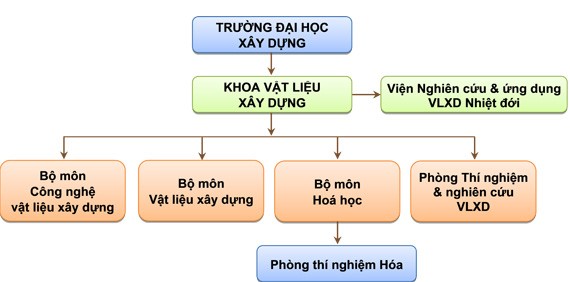
Faculty Board
- Assoc. Prof. Dr. Van Viet Thien An - Head of Department
- Dr. Nguyen Trong Lam - Deputy Head of Department
- Dr. Le Manh Cuong - Deputy Head of Department
Staff
- Faculty: 39 people, including: 13 senior lecturers, 13 principal lecturers; and 13 lecturers.
- Administrative/Training Support Staff: 8
- Outstanding Teacher: 2
- Professors: 2; Associate Professors: 11
- Doctor of Science: 2; PhD: 15; Master's Degree: 11; Bachelor's Degree: 8
Training program
University level
a) Field/Specialization of study:
b) Training system
- Regular program:
- Bachelor's degree (level 6): training duration is 4 years;
- Engineer (Level 7): Training duration is 5 years (for students with a Level 6 diploma in the relevant field);
- Dual degree program, second degree: students retain the grades of courses with equivalent content and knowledge volume in their first degree program;
- Work-study programs: training time is usually 0.5 years longer than full-time programs;
- University transfer program: for those who have graduated in the same or related field from a college-level program.
Postgraduate level
- Master's degree in Materials Engineering, with a duration of 1-2 years.
- Doctoral degree in Materials Engineering, with a study duration of 3-4 years.
Training objectives
- The goal is to train graduates/engineers with strong political and ethical qualities, knowledge, and the ability for lifelong learning; possessing specialized skills and competencies to lead the solution of problems related to the conception, design, implementation, and operation of production processes, applications, and research and development of materials and new materials; increasing the efficiency of material use, contributing to environmental protection and sustainable development; and having the capacity for scientific research, innovation, and creativity to meet the country's development needs in the context of the Fourth Industrial Revolution and international integration.
- Master's/Doctoral training: Graduates should possess political and ethical qualities, knowledge, and the ability to learn throughout their lives; have in-depth interdisciplinary knowledge, the ability to create and develop basic research results, and apply core technologies to technological solutions, management processes, and designs in the field of materials; possess broad knowledge in the field of materials production, and have research skills and independent, creative thinking to adapt to the demanding labor and production environment. They possess high professional qualifications, professional responsibility, and a sense of community service for the sustainable development of the country and international integration.
Scientific research
- Faculty members of the Department of Building Materials have participated in and led numerous national, ministerial, provincial, and university-level scientific research projects; implemented many pilot production and technology transfer projects, and international science and technology projects. The outstanding results in the Department's scientific research and technological development activities are concentrated in the following main areas:
- Planning policies for the development of building materials.
- Application of new building materials in construction.
- Research on using waste materials for sustainable construction development.
- Improving construction materials technology towards modernization, enhancing material quality, and saving energy and resources.
- With its broad and in-depth training objectives and content, graduates from the Department of Building Materials are capable of working in a wide range of organizations and fields:
- These companies manufacture and process materials, produce supplies and equipment for civil and industrial use, across various sectors: ceramics, glass, cement, concrete; polymer-composite, paint, plastics, chemicals, additives, mineral extraction and processing, etc.
- Consulting, supervision, management, and quality control of materials and construction work for building projects.
- Companies that manufacture and trade materials, both domestic and foreign.
- Training and scientific research institutions such as schools and institutes in the field of materials science.
- The agencies responsible for managing and inspecting the quality of raw materials include: ministries and departments, customs, and the Center for Standards, Metrology and Quality...
- There are many opportunities for higher education due to the interconnectedness of materials science among universities and research institutes both domestically and internationally.






Contact
- Address: Rooms 314 and 315, Building A1, Hanoi University of Civil Engineering, 55 Giai Phong Street, Bach Mai Ward, Hanoi City.
- Phone: 02438693571 Mobile: 0865.163.929
- Website: https://vatlieu.huce.edu.vn/
- Email: vatlieu@huce.edu.vn